
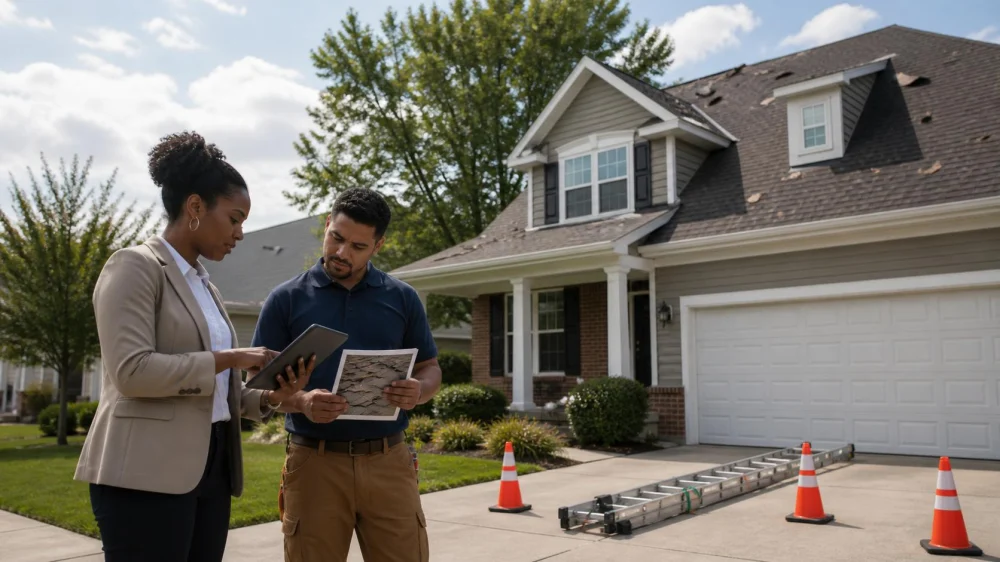
Roof Access for Insurance Adjusters: Coordinate Safety and Scope
On this page
Quick answer
Before an insurance adjuster visits, confirm who will attend, whether anyone expects roof access, and which party controls ladders and fall protection. Photograph damage from safe ground positions, preserve receipts and temporary-repair records, and give the adjuster a concise timeline. Do not climb the roof, move hazardous debris, or delay urgent weatherproofing solely to preserve evidence.
Victors Home Solutions / victors roofing
2722 E Michigan Ave suite 239, Lansing, MI 48912, USA
Why it matters
A coordinated adjuster visit helps the owner, insurer, and roofing contractor discuss the same observed damage without creating an unmanaged access or evidence problem.
This United States guide is general information. Policy terms, state claim rules, licensing, weather, roof type, and site hazards vary. The insurer decides coverage; a roofer evaluates roofing work, and neither role replaces emergency services or structural expertise.

Rapid Response Roofing / rapid response roofing
East GreenvilleMontgomery CountyPennsylvania
408 State St, East Greenville, PA 18041, USA
Practical checklist
- Ask the insurer for the adjuster's name, arrival window, identification process, and requested documents.
- Tell the insurer about steep slopes, solar equipment, fragile materials, active leaks, utilities, pets, gates, or restricted areas.
- Confirm whether your roofing contractor may attend and how each party will share observations.
- Prepare dated photos, a loss timeline, prior condition records, estimates, receipts, and temporary-repair documentation.
- Keep vehicles, children, pets, and visitors outside ladder and falling-debris zones.
- Designate one contact who can answer access questions and record next steps.
- Request a written explanation of any additional evidence or inspection that is needed.
Step-by-step plan
- Stabilize urgent hazards first. Prevent entry beneath loose material, shut off affected utilities when instructed, and arrange emergency weather protection where safe.
- Open the claim through the insurer's official channel and record the claim number, contact details, and reporting time.
- Build a short evidence packet. Include overview and close photos taken safely, dates, weather, affected rooms, and invoices without editing original files.
- Set access rules before arrival. Agree who supplies ladders, who may climb, what fall-protection method applies, and which areas remain off limits.
- Walk the exterior from the ground together. Point out observations without directing anyone into an unsafe area or presenting assumptions as confirmed causes.
- Separate roles in the discussion. Ask the roofer for repair scope and the adjuster for claim documentation and coverage process.
- Close the visit with a written task list, including requested documents, temporary work, follow-up inspection, estimates, and response dates.
Retain original photos and video, claim correspondence, adjuster identification, contractor credentials, weather data, estimates, invoices, material samples when safely available, and a dated contact log.
Limits and warning signs
A visual visit may not reveal concealed deck, insulation, framing, flashing, or moisture damage. Roofing estimates do not determine insurance coverage, and an insurer's scope may not be a construction specification. Never use an adjuster visit as a reason to enter an unstable building or climb a storm-damaged roof.
Call emergency services for collapse, fire, gas odour, downed lines, or immediate danger. Use qualified structural, electrical, water-mitigation, environmental, or roofing professionals when damage extends beyond a routine roof inspection.
Frequently asked questions
Should my roofer attend the adjuster visit?
Ask the insurer. A roofer can identify repair details, while the adjuster documents the claim and applies policy procedures.
Do I need to wait before temporary repairs?
Protect people and prevent further damage when safe. Photograph first if practical, keep damaged material when instructed, and save every receipt.
Can I lend the adjuster my ladder?
Do not improvise access. Confirm in advance who controls equipment, inspection methods, and fall protection.
What if the scopes differ?
Request written, itemized explanations and supporting photos, then use the insurer's review process and qualified contractor documentation.
Sources and evidence
The article reflects common United States claim and roofing-safety practice: report promptly, mitigate further damage, preserve original evidence and receipts, define roof access, and keep coverage decisions separate from construction scope.
Conclusion and next steps
Confirm the appointment and roof-access plan, assemble a dated evidence packet, and invite the roofer only with the insurer's knowledge. Keep everyone outside hazard zones and leave elevated inspection to properly equipped professionals.


 Austin All Roof - Pflugerville4.0 (14 reviews)
 JJ Contracting Roofing Co5.0 (1 reviews)
 The Roofing Company3.0 (23 reviews)
 Farha Roofing4.0 (172 reviews)
 INALFA ROOF SYSTEMS0.0 (0 reviews)
 Eagles Roofing and Reconstruction LLC4.0 (4 reviews)
 How to Notify Neighbours Before Roofing Work Starts
 The Environmental Impact of Your Roofing Choices
 What to Do If Your Roof Starts Leaking During a Storm
 A Homeowner's Guide to Filing an Insurance Claim for Roof Damage Successfully
 Everything You Need to Know About Insurance Claims for Roof Damage
 The Pros and Cons of a M-Shaped Roof Design for Larger Homes