
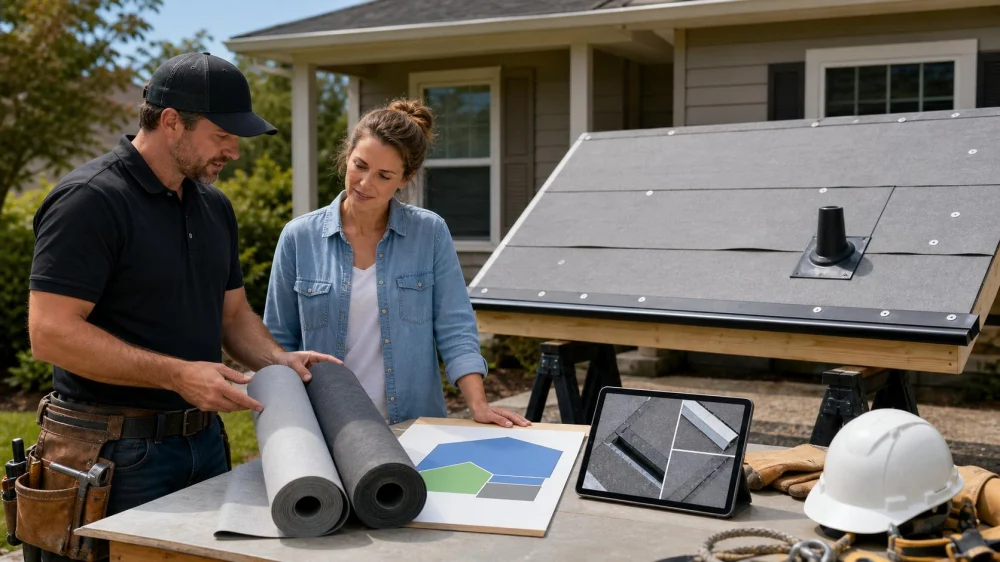
Roof Underlayment: Define What Goes Under New Shingles
Shingles are visible, but the layer beneath them helps manage water before it reaches the roof deck. “Install underlayment” is too vague for a replacement contract. Homeowners should know the exact product, where self-adhered membrane is used, how laps and penetrations are integrated, and what photos will prove the hidden work before shingles cover it.
Quick answer
Put the underlayment system in writing: manufacturer and product, applicable standard, number of layers, attachment method, lap pattern, roof areas receiving self-adhered membrane, and integration with drip edge and flashing. Require compatibility with the roof covering, local code, climate, slope, deck, and manufacturer instructions. Ask for labelled product photos and wide installation photos before shingles hide the work.

JK Contractors / jk roofing
West BendOzaukee CountyWisconsin
3058 County Rd Y, West Bend, WI 53095, USA
Understand the underlayment’s role
Underlayment is a water-shedding or water-resistant layer installed above the roof deck and below the primary covering. It can provide temporary protection during construction and a secondary layer when wind-driven rain or damaged shingles allow water past the surface.
It is not a substitute for sound decking, correct flashing, adequate slope, drainage, ventilation, or properly installed shingles. Water still needs a continuous path down and out. Fastener holes, laps, wrinkles, cuts, and poorly integrated penetrations can reduce performance.
A “sealed roof deck” is a specific enhanced approach, not a synonym for any synthetic sheet. It uses a defined method to reduce water entry through deck seams if the roof covering is lost. If that performance is promised, name the standard or program and verification process.

SB Pro Roofing / sb pro roofing
Pinellas ParkPinellas CountyFlorida
6358 49th St N, Pinellas Park, FL 33781, USA
Compare systems, not labels
Common categories include asphalt-saturated felt, synthetic sheet underlayment, and self-adhered membrane. Each category contains products with different ratings, surfaces, exposure limits, fastener requirements, temperature ranges, and roof-cover compatibility.
Felt has a long history but can wrinkle or tear when wet and may have shorter exposure limits. Synthetic sheets can be lighter and more tear resistant but are not all equivalent. Self-adhered membranes can protect vulnerable areas and seal around some fasteners, but deck preparation, temperature, adhesion, and material compatibility matter.
Do not select on colour, marketing name, or roll width alone. Ask for the current product data sheet and installation instructions for the exact roof assembly.
Define coverage in the scope
The contract should answer:
- Which product covers the main roof field?
- Is one layer or more required for the slope and local code?
- Where will self-adhered membrane be installed—eaves, valleys, rakes, walls, chimneys, skylights, or penetrations?
- How far will each membrane extend, and from which reference point?
- Which fasteners, cap types, spacing, and lap dimensions apply?
- How long may the installed layer remain exposed?
- What happens if rain, wind, wrinkles, tears, or contamination occur before covering?
- How are low-slope sections or transitions handled?
Use product names and measurable areas. Phrases such as “ice shield as needed” leave too much unresolved.
Coordinate edges, valleys, and penetrations
Underlayment must work with the surrounding details. At eaves and rakes, the sequence with drip edge can vary by location, code, manufacturer, and system. Valleys may use self-adhered membrane plus a metal or shingle valley assembly. Walls and chimneys require step or other flashing integrated so water drains onto the layer below.
Plumbing vents, skylights, exhaust caps, and roof-to-wall transitions interrupt the field. The crew should plan membrane cuts, laps, flashing sequence, and compatible sealants before placing shingles. Smearing roof cement over a gap is not a substitute for a correctly layered assembly.
FEMA’s sloped-roof guidance notes that flashing needs to be integrated with shingles and underlayment to prevent water entry.
Account for the deck and weather
The roof deck should be dry, clean, smooth enough for the chosen material, properly fastened, and repaired where damaged. Self-adhered products can fail to bond to dust, frost, moisture, oil, incompatible coatings, or cold surfaces. Gaps and sharp edges can damage sheets.
Agree on weather limits and shutdown procedures. Wind can lift unsecured sheets; rain can get beneath incomplete laps; heat can make some surfaces slippery; and cold can reduce adhesion. The crew should follow the product’s temperature and exposure instructions.
If decking replacement is discovered after tear-off, document the area and price before continuing when practical. New underlayment should not hide unresolved rot or an uneven substrate.
Verify hidden work before covering
Arrange a photo checkpoint. Useful evidence includes:
- roll labels and lot information;
- wide views of each roof plane;
- laps and capped fasteners at representative areas;
- eaves, rakes, valleys, walls, chimneys, skylights, and penetrations;
- repairs to tears, fishmouths, wrinkles, or damaged decking;
- the transition between low- and steep-slope roof areas;
- inspection records when the jurisdiction or program requires them.
Photos do not replace inspection, but they make the hidden scope reviewable. Ask the contractor to explain any departure from the written plan before the shingles cover it.
Code, warranty, and safety limits
Underlayment requirements vary by jurisdiction, adopted code edition, design wind, roof covering, slope, climate, and manufacturer. A permit office, design professional, manufacturer, fortified-program evaluator, or qualified roofing contractor may need to determine the correct assembly. Marketing claims do not override local code or installation instructions.
This article is general planning information. Do not walk on an exposed or underlayment-covered roof; it can be slippery, loosely fastened, and unprotected at edges. Review the work from the ground and through contractor photos or authorized inspections.
Frequently asked questions
Is synthetic underlayment always better than felt?
No. Product rating, installation, roof assembly, exposure, code, and manufacturer compatibility matter more than the broad category.
Does ice-and-water membrane belong over the whole roof?
Sometimes a full self-adhered system is specified, but many projects use it only in defined vulnerable areas. Full coverage can change moisture behaviour and installation details, so use an approved design.
Can old underlayment stay during reroofing?
The contractor must evaluate the assembly, code, deck access, covering instructions, and scope. Do not assume that leaving hidden layers supports a complete deck inspection.
How can I verify material after shingles are installed?
Keep roll-label photos, delivery records, installation photos, invoices, permits, inspections, and warranty registration. Verification is much harder after covering.
Next steps
Ask each bidder for an underlayment map and exact product data. Reconcile it with the roof covering instructions, local code, slope, and warranty. Put coverage and photo checkpoints in the contract. Before shingles begin, review labelled materials and the completed hidden layer so the roof record shows what is actually underneath.
 Certified Roofing5.0 (9 reviews)
 RN Palmer Roofing4.0 (8 reviews)
 Coastline Roofing Company LLC4.0 (55 reviews)
 DM Roofing Siding & Windows5.0 (14 reviews)
 Eenigenburg Roofing4.0 (30 reviews)
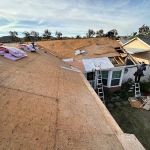 Alvarado General Roofing, Roofing Service in La Puente CA, Roofers in La Puente CA5.0 (9 reviews)
 The Best Roofing Materials for a Home in a Heavy Rainfall Climate
 Roof Replacement Cost Breakdown by Labor and Materials Explained
 Roof Replacement Permit Cost Explained: Fees, Factors, and What Homeowners Should Know
 Asphalt Shingles vs Metal Roofing: Pros, Cons, and Cost Comparison
 Cost to Replace Roof Soffit and Fascia: Complete Guide for Homeowners
 How to Clean Your Roof Without Damaging the Shingles' Fire Rating