
Roofing Permits and Inspections: Assign Responsibility in Writing
Table of contents
Quick answer
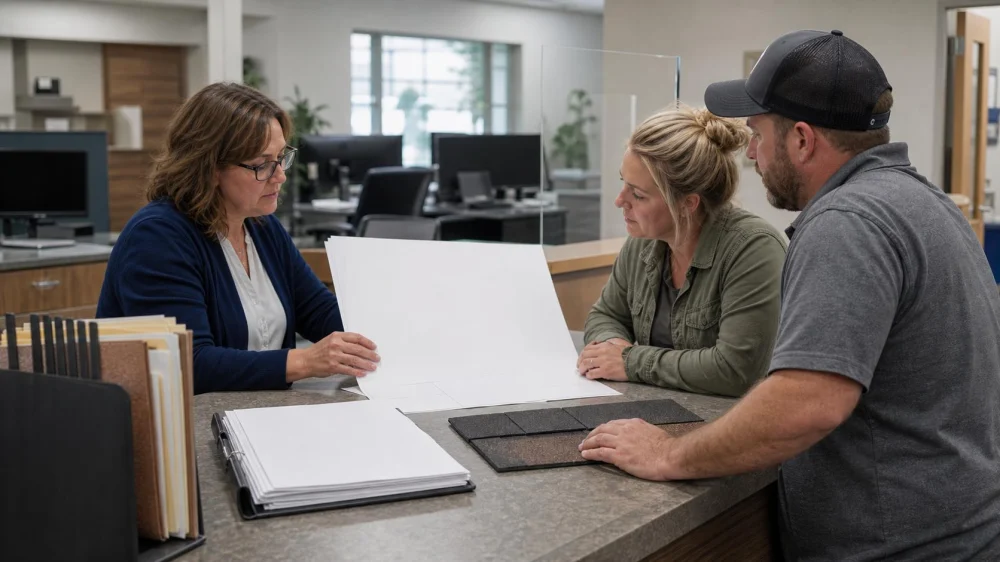
Roofing permit and inspection rules differ by city, county, state, building type, and project scope. Ask the local building department before work, then name in the contract who applies, pays fees, schedules inspections, corrects failed work, and obtains final closure. Verify the permit independently and keep the issued record, inspection results, and closeout proof.
Lance Roofing & Siding Inc. / lance roofing and siding
6903 Dayton Springfield Rd, Enon, OH 45323, USA
Rules vary by jurisdiction
One city may require a permit and multiple inspections for a residential reroof, while another may exempt limited repair or use affidavits and photographs. Additional requirements can apply when decking, structure, insulation, solar equipment, roof weight, or building use changes.
Official examples show this variation: Orlando requires a residential reroof permit and may inspect dry-in conditions, while Seattle’s commercial and multifamily reroof process can close through an affidavit without an on-site inspection. Do not copy a rule from another location.

Gunner Roofing / gunner roofing
CromwellLower Connecticut River Valley Planning RegionConnecticut
700 Corporate Row, Cromwell, CT 06416, USA
Put responsibility in the contract
- exact permitting jurisdiction and project address;
- permit applicant and licensed contractor of record;
- fees, drawings, product approvals, and notices included in price;
- inspection stages and who schedules each one;
- access, weather delay, and failed-inspection responsibilities;
- change process if concealed damage alters the permit scope;
- final payment conditioned on required closure documentation.
Ask for the permit number before materials are installed. Use the jurisdiction’s official portal or phone number to verify status rather than relying on a photo of an application.
Track inspections and closeout
- Save the issued permit and approved scope.
- Record required inspection stages before tear-off begins.
- Confirm the crew does not cover work that must remain visible.
- Keep correction notices and proof that they were resolved.
- Obtain the final inspection result, affidavit, certificate, or other closure record used locally.
- Match warranties and invoices to the permitted contractor and installed products.
A permit application is not the same as an issued permit, and an issued permit is not automatically closed when the roof looks finished.
Owner-builder caution
Pulling a permit as an owner-builder can shift legal, safety, insurance, supervision, and subcontractor responsibilities to the homeowner. Some jurisdictions require a declaration and in-person acknowledgement. Do not use owner-builder status merely to let an unqualified contractor avoid licensing or registration rules.
Limitations
This is a contract-management guide, not legal or code advice. Current requirements depend on the exact address, building type, valuation, scope, and adopted codes. Homeowner associations, insurers, historic districts, and fire or wind zones may add separate approvals.
FAQ
Who normally pulls the permit?
It varies. Some jurisdictions assign it to the contractor; others allow an owner. Confirm locally and state it in writing.
Can work start while the application is pending?
Do not assume so. Start only when the authority confirms the permit is issued or the work is exempt.
What if the contractor says no inspection is needed?
Verify directly with the building department because inspection methods and stages differ.
Should final payment wait?
A reasonable contract can tie final payment to required inspection and closeout records, along with other completion milestones.
Sources and evidence notes
- City of Orlando: Residential Roof Permit — application and dry-in inspection example.
- Seattle: Re-Roof Permit — scope and affidavit closeout example.
- City of Bryan: Roofing Permits and Inspections — contractor responsibility and final inspection example.
Next steps
Call the authority for the project address, list every permit and inspection stage, and assign each task in the contract. Verify issuance before work and keep final closure proof before releasing the last payment.


 Know-A-Guy Roofing & Exteriors, LLC4.0 (53 reviews)
 Baran & Son Roofing4.0 (27 reviews)
 Urban Enterprise Construction LLC5.0 (20 reviews)
 The Roof Doctor4.0 (81 reviews)
 Expert Exteriors LLC4.0 (261 reviews)
 SafePro Roofing & Siding0.0 (0 reviews)
 How to Inspect Your Roof from the Ground: A Simple Guide for Homeowners
 The Real Cost of Ignoring a Small Roof Leak and How to Protect Your Home
 The Best Roofing Materials for a Mediterranean or Spanish-Style Home
 Roofing Worksite Access: Plan Doors, Gates, and Visitors
 The Signs of UV Damage on an Asphalt Shingle Roof: Cracking and Curling
 The Real Cost of Ignoring a Small Roof Leak