
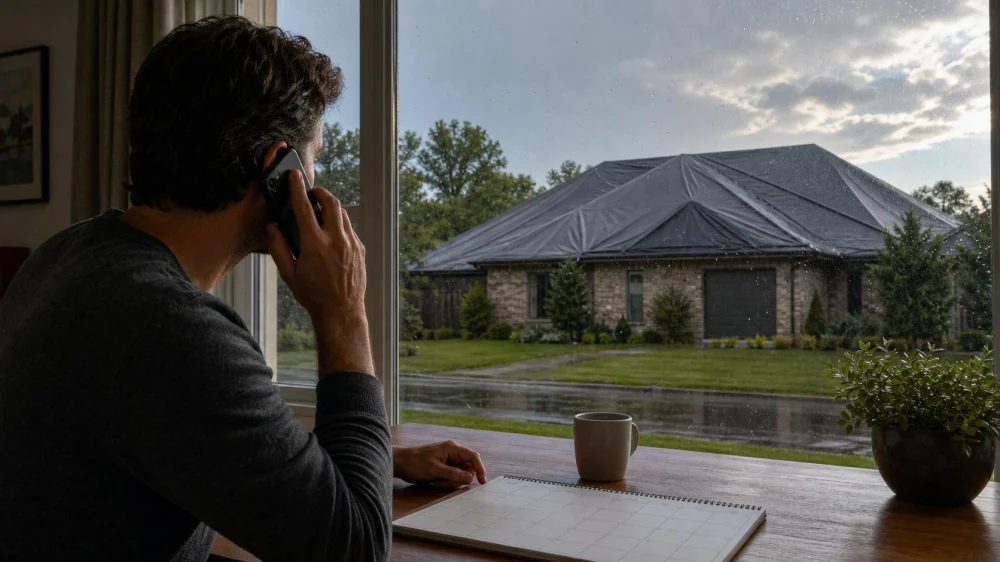
Roofing Weather Delays: Questions to Ask Your Contractor
On this page
- Quick answer
- Set the weather plan before work starts
- Understand how forecasts are used
- Ask how an open roof will be protected
- Confirm material storage
- Know what happens on a delay day
- Define the restart check
- Monitor the home from inside
- Track schedule and cost changes
- Safety boundaries and limitations
- Weather-delay checklist
- Frequently asked questions
- Sources and evidence notes
- Next steps
Quick answer
Before roofing begins, ask who monitors weather, who can pause work, how opened areas are dried in, how materials are secured, and how the crew communicates delays and restarts. During a delay, stay out of the work zone, check the home from inside, document any leak promptly, and wait for the contractor to inspect roof conditions before work resumes.
Weather delays are not simply lost calendar days. Rain, wind, snow, ice, heat, cold, and lightning can affect worker safety, material handling, adhesion, moisture, and installation requirements. The contractor should combine the forecast, current site conditions, manufacturer instructions, and a job-specific safety plan.

Rapid Response Roofing / rapid response roofing
East GreenvilleMontgomery CountyPennsylvania
408 State St, East Greenville, PA 18041, USA
Set the weather plan before work starts
Review weather procedures in the contract and preconstruction meeting. A useful plan identifies decision makers, protection steps, communication, schedule effects, and responsibility for emergency response.
Ask:
- Who checks the forecast and on-site conditions?
- Who has authority to postpone delivery, tear-off, installation, or cleanup?
- How much roof will be opened at one time?
- What temporary dry-in system will be available?
- How will coverings be secured against wind without damaging the home?
- How are exposed decking, insulation, and the attic checked after precipitation?
- Where will underlayment, shingles, membranes, adhesives, coatings, and tools be stored?
- How will the contractor contact the homeowner before a delay or restart?
- What contract terms apply to weather days, extended conditions, and additional protection?
Record the site lead’s mobile number and the after-hours leak contact. Decide whether text, email, or a project portal is the official record. Confirm who can authorize a change in scope or cost; a crew member’s casual comment should not become an undocumented change order.
Lance Roofing & Siding Inc. / lance roofing and siding
6903 Dayton Springfield Rd, Enon, OH 45323, USA
Understand how forecasts are used
A weather app icon is only one input. Contractors may review precipitation timing, radar, wind speed and gusts, temperature, humidity, dew point, heat index, lightning, snow or ice, and overnight conditions. Roof slope, shade, drainage, material, building height, and task all affect the decision.
Some decisions occur in stages:
- Pre-start: decide whether to mobilize, deliver, or begin tear-off.
- During work: watch changing clouds, wind, radar, temperature, and surface condition.
- Stop-work: secure the roof, materials, tools, and ground before conditions become unsafe.
- Post-weather: inspect moisture, footing, coverings, equipment, and product suitability.
- Restart: document that the planned task can proceed under safe and manufacturer-acceptable conditions.
A forecast that proves less severe than expected does not make a cautious pause unreasonable. Conversely, a sunny forecast does not override actual wet, icy, windy, or lightning conditions.
Ask how an open roof will be protected
The contractor should limit exposed areas to what the crew can protect within the planned weather window. Ask what “dried in” means for this roofing system and stage. Decking, underlayment, flashing transitions, penetrations, valleys, and edge details may have different temporary needs.
Temporary coverings should be selected, installed, and secured by the contractor. Loose tarps can catch wind, direct water into the building, cover hazards, or require dangerous emergency work. Homeowners should not climb up to tighten them.
Request photos at the end of a weather shutdown showing protected openings, material storage, and the condition of relevant attic or ceiling areas. Photos do not prove that hidden assemblies are dry, but they create a useful project record.
If water enters, report the exact room, time, weather, stain shape, active dripping, and any nearby fixture or roof feature. Move people and belongings away from the drip only when it is safe. Do not enter an attic with wet electrical equipment, a sagging ceiling, or uncertain footing.
Confirm material storage
Roofing products have manufacturer-specific storage and installation conditions. Temperature, moisture, direct sun, stacking, orientation, ventilation, and shelf life may matter. Ask the contractor to identify the instructions for the actual products in the contract.
Confirm how the crew will protect:
- shingle bundles from water, overheating, bending, and unstable stacking;
- roll roofing, membranes, and underlayment from damage or wind;
- metal panels and flashing from moisture trapping, scratches, and movement;
- adhesives, primers, sealants, and coatings from prohibited temperatures;
- insulation and wood products from wet storage;
- fasteners and tools from corrosion or loss.
Do not wrap, move, or heat materials yourself. An improvised cover may trap condensation, and a homeowner space heater or extension cord can create fire and electrical hazards. Report a loose covering or wet package from a safe location.
Know what happens on a delay day
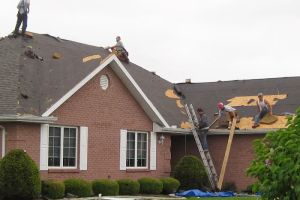
A full stop, late start, partial workday, and no-tear-off day are different. Ask the contractor to state which applies and what work, if any, will continue safely. Ground-level organization or interior documentation may proceed while roof work pauses, but the contractor controls the plan.
Before the crew leaves, confirm:
- the roof and openings are protected;
- loose materials, tools, ladders, and debris are secured or removed;
- gutters and temporary drainage paths are not intentionally blocked;
- the waste bin and packaging are prepared for wind and rain;
- the household has a safe entrance;
- children and pets cannot reach stored materials;
- the next update time and emergency contact are clear.
Do not remove barriers or use an exterior area simply because no crew is present. Wind can move materials, and wet surfaces can remain hazardous after rain ends.
Define the restart check
Work should not restart only because precipitation stopped. The contractor needs to evaluate roof surface condition, wind, lightning, ice, temperature, moisture, fall-protection systems, access, tools, and materials.
Ask whether exposed wood or insulation became wet and how condition and drying will be assessed. Covering moisture without evaluation can affect the assembly. The appropriate response depends on the material, exposure, duration, manufacturer requirements, and professional judgment.
For temperature-sensitive adhesives, membranes, sealants, and coatings, request confirmation that current and near-term conditions meet written product requirements. Cold materials may need approved conditioning; hot surfaces may also create limits. Do not accept a generic “it feels dry” as the only check when the manufacturer specifies more.
Request an updated sequence and completion estimate after the restart decision. Make sure a compressed schedule does not silently change ventilation, flashing, inspection, or cleanup work promised in the contract.
Monitor the home from inside
During and after weather, check ceilings, upper walls, skylight wells, attic hatch areas, chimneys, and known leak locations from stable indoor surfaces. Use dated photos. Watch for new stains, drips, bulging finishes, unusual odours, damp insulation visible from the hatch, or electrical problems.
If water is near a light fixture, electrical panel, outlet, or wiring, keep people away and contact the contractor and appropriate emergency or electrical service. Do not touch wet electrical equipment. For a sagging ceiling, leave the area below because waterlogged material can fall.
Place a container under a simple drip only when the area is electrically safe and the ceiling is stable. Protect belongings without climbing on furniture. Report the issue immediately; the contractor should determine the roof-level response.
Keep a weather log with the time, conditions, contractor messages, photos, and interior observations. It helps distinguish the sequence without asking the homeowner to diagnose the roofing defect.
Track schedule and cost changes
Review how the contract treats excusable weather delays, material storage, remobilization, temporary protection, and completion dates. Laws and contract terms vary, so obtain local legal advice for a dispute rather than relying on a general article.
Ask for an updated written schedule after each material delay. Record which days were full stops, partial days, or productive ground work. Coordinate parking, pets, work-from-home plans, deliveries, and access with the new dates.
A weather delay should not automatically produce an open-ended charge. Ask for the contract basis, scope, quantity, and price before authorizing extra work. Hidden damage discovered after tear-off is a separate issue and should be documented through the agreed change-order process.
Do not pressure a crew to continue unsafe work to meet a personal deadline. Plan a buffer before travel, sale closing, inspection, or another trade. Weather-sensitive construction needs schedule flexibility.
Safety boundaries and limitations
OSHA requires employers to evaluate and control construction hazards. Falls are a major risk in residential roofing, and adverse weather can affect footing, equipment, materials, and safe access. Worker safety decisions belong to the employer and competent site personnel.
The National Weather Service warns that no place outside is safe during a thunderstorm. If thunder is heard, stay away from roofs, ladders, scaffolds, trees, and large equipment and move to a substantial building or hard-topped metal vehicle according to the site plan.
Homeowners should not inspect a wet roof, hold tarps, move ladders, clear roof drains, or help secure materials. This guide is general U.S. consumer information, not a weather forecast, work procedure, engineering assessment, warranty interpretation, or legal opinion.
Weather-delay checklist
- Identify the weather decision maker and update channel.
- Confirm how much roof may be opened at once.
- Review temporary dry-in and emergency leak procedures.
- Ask how every product will be stored and secured.
- Record the after-hours contact.
- Stay out of the site during shutdown and dangerous weather.
- Check the home from stable indoor locations.
- Report leaks with time, location, photos, and nearby features.
- Ask how surfaces and materials were assessed before restart.
- Get revised dates and cost changes in writing.
Frequently asked questions
Can roofers work in light rain?
The contractor must assess the task, roof, footing, equipment, materials, forecast, and applicable safety requirements. A homeowner should not decide that conditions are safe based on rainfall intensity alone.
Who should cover the roof when rain starts?
The roofing contractor should plan and install temporary protection. Homeowners should not climb onto the roof or try to secure tarps in wind or lightning.
Does rain ruin delivered shingles?
It depends on the product, packaging, storage, and exposure. Ask the contractor to inspect materials and apply the manufacturer’s written instructions before installation.
When can work restart after a storm?
After competent site personnel determine that weather, access, footing, fall protection, roof assemblies, tools, and materials are suitable for the planned work.
What should I do if the ceiling starts dripping?
Keep people away from electrical hazards or a sagging ceiling, contact the contractor immediately, and document the location and time from a safe place. Use emergency services when conditions present an immediate danger.
Do weather delays always increase the price?
Not automatically. Review the written contract. Require a documented scope and contract basis for additional charges, and seek local advice if there is a dispute.
Sources and evidence notes
- Occupational Safety and Health Administration: Residential Fall Protection Guidance explains employer responsibilities for controlling fall hazards during residential roofing work.
- National Weather Service: Lightning Safety on the Job identifies construction exposure and directs outdoor workers to safe shelter when thunderstorms threaten.
- OSHA: Residential Fall Protection Overview provides current federal roofing and residential construction safety resources.
The communication and documentation steps organize those official safety principles for homeowners. They do not set stop-work thresholds for a particular crew, product, roof, or jurisdiction.
Next steps
Add five weather questions to the preconstruction meeting: who decides, how the roof is dried in, how materials are stored, when updates arrive, and how restart is verified. Save the emergency contact, photograph current ceilings, and create a simple weather log. Let the contractor control all roof-level protection and safety decisions.


 Bell Roofing Co4.0 (5 reviews)
 RAA Roofing5.0 (10 reviews)
 Roof Smith5.0 (34 reviews)
 Panda Roof4.0 (536 reviews)
 Roofing Empire, Inc.4.0 (46 reviews)
 Fisher's Roofing & Siding4.0 (27 reviews)
 Installing a Modified Bitumen Roof for a Low-Slope Garage: Step-by-Step Process
 How to Finance a New Roof Without Breaking the Bank
 Average Labor Cost for Roof Replacement in the US
 How to Tell If Your Roof Was Installed Properly | Expert Roofing Tips
 How Roofing Affects Home Resale Value: Boosting Curb Appeal and ROI
 Roof Leak Repair Around Vent Pipe Cost: What Homeowners Should Know