
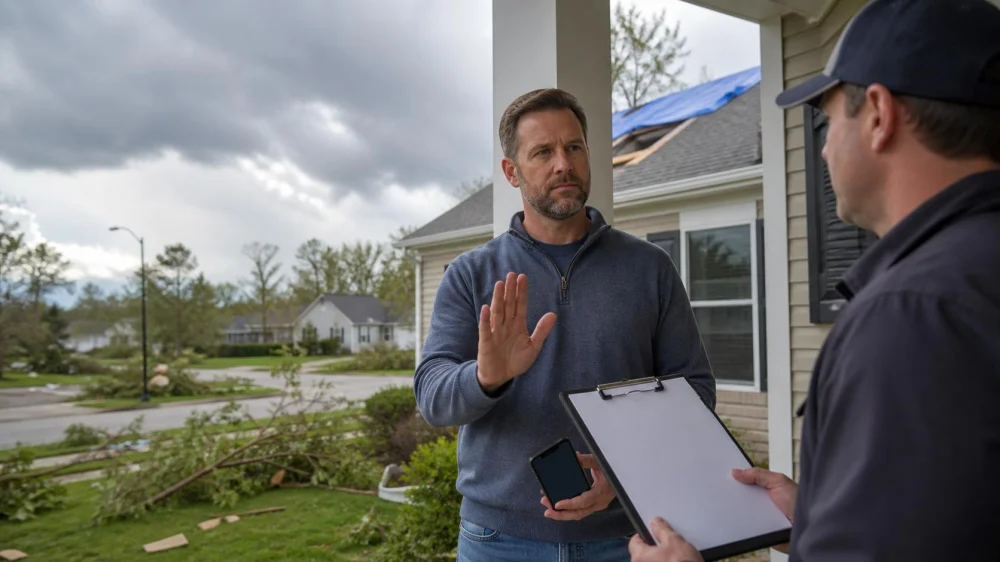
Storm-Damage Roofing Offers: Pause Before You Sign
On this page
Quick answer
After a storm, protect people and prevent additional damage, but do not let urgency force a roofing contract. Photograph damage from the ground, contact your insurer through its official number, and get temporary work documented. Independently verify contractor license, insurance, address, references, and complaint history; compare several written estimates. Reject pressure, cash or wire demands, blank documents, and claims of FEMA endorsement. Read financing, insurance-authority, cancellation, and payment terms before signing.

Holden Roofing (Houston Corporate) / holden roofing
RosenbergFort Bend CountyTexas
2128 1st St, Rosenberg, TX 77471, USA
Secure urgent damage first
Stay away from fallen lines, unstable structures, wet electrical areas, and the roof. Call emergency services or the utility for immediate hazards. Photograph visible damage from safe ground locations and inside the building without entering unsafe areas.
Contact your insurer promptly using the number on your policy or official website. Ask what emergency mitigation is covered, what documentation is required, and whether an adjuster should inspect before permanent repair.
Use a qualified, insured professional for temporary covering. The work order should identify the emergency scope, price, photos, and whether it authorizes only mitigation or also future replacement.

SB Pro Roofing / sb pro roofing
Pinellas ParkPinellas CountyFlorida
6358 49th St N, Pinellas Park, FL 33781, USA
Recognize pressure tactics
FTC materials warn about unsolicited contractors who say they are “in the area,” have leftover materials, demand an immediate decision, request full payment up front, insist on cash, or steer the homeowner to a particular lender.
Other warning signs include claiming the deal expires before an insurer can respond, offering to absorb a deductible without explaining legality, asking you to sign on a phone without seeing all pages, or calling an inspection form when it is actually a work authorization.
FEMA does not endorse or certify commercial contractors. A worker claiming to be “with FEMA” should not be treated as a roofer sent to repair the home.
Verify the business independently
Get the legal business name, physical address, license number, insurance details, supervisor, and subcontractor list. Search official state and local licensing records and contact the insurer through independently located details.
Ask local customers about projects completed before the storm, not only recent emergency work. Check state attorney general or consumer protection sources for complaints and enforcement information.
Get several written estimates for equivalent scope. A very low bid may omit deck repair, flashing, permits, disposal, code upgrades, or required roofing-system components.
Coordinate with your insurer
A contractor can document roof conditions and estimate work, but the insurer decides coverage under the policy. Do not accept a promise that insurance will “definitely pay everything.” Confirm deductible, depreciation, exclusions, code coverage, and payment process with the insurer.
Understand any document that authorizes the contractor to communicate with the insurer, receive checks, negotiate, or act on your behalf. Authority forms and assignment-of-benefits rules vary by state and can have major consequences; seek legal advice before transferring rights.
Do not endorse a joint check or release funds until you understand who will receive them and what completed milestone the payment covers.
Read every document
FTC guidance recommends a written contract with the contractor’s identity and license, start and completion dates, scope, materials, price, and promises made. Fill all blank spaces and keep a complete copy.
Review cancellation rights. The FTC’s Cooling-Off Rule can apply to certain sales made at a home or temporary location, but exemptions and state rules matter, especially for emergency repairs. Do not assume a three-day right applies to every storm contract; verify with the FTC, state agency, or lawyer.
Separate temporary mitigation, inspection, permanent repair, financing, and insurance authorization into clearly understood commitments. A signature for one purpose should not quietly approve another.
Control payments and records
Do not pay the full project price in advance. Check state limits on deposits and use a milestone schedule tied to documented progress. Avoid cash, wire transfers, gift cards, cryptocurrency, or payment to an unrelated individual.
Keep the ad or door hanger, photographs, estimates, contract, change orders, permits, insurance correspondence, invoices, receipts, license searches, and payment proof. Record dates and the names of everyone who communicates with you.
Report suspected fraud to local law enforcement, the state attorney general or consumer protection office, the FTC at ReportFraud.ftc.gov, and FEMA’s fraud resources when someone misrepresents a federal role.
Limitations and important notes
Contract, cancellation, insurance, licensing, deductible, lien, and assignment rules vary by state. This guide is not legal or insurance advice.
Reasonable emergency mitigation may be time-sensitive. The goal is to authorize only the documented urgent work while preserving time to verify and compare permanent-repair proposals.
Sources and evidence notes
- FTC: Home Repair Scams
- FTC: How to Avoid a Home Improvement Scam
- FEMA: Beware of Fraudulent Contractors
Frequently asked questions
Should I let a door-to-door roofer inspect?
Verify the company first. Do not allow roof access or sign a form until you understand the business and the document.
Does FEMA send roofers?
FEMA does not certify or endorse commercial repair contractors. Verify any federal representative through official FEMA channels.
Can a contractor guarantee insurance coverage?
No. Coverage depends on the policy, damage, and insurer’s decision. Confirm it directly with the insurer.
Is a free inspection harmless?
Not always. The form may authorize work or insurance communication. Read every page before agreeing.
What if water is entering now?
Authorize only clearly documented emergency mitigation with a qualified insured provider, then compare permanent repairs separately.
Next steps
Make the property safe, document damage, and contact the insurer. For each contractor, verify identity, license, insurance, local history, and references; then compare written estimates. Read the entire contract and any financing or insurance document, confirm cancellation and deposit rules for your state, and pay by traceable milestones. Report false federal claims or suspected fraud promptly.
 G&G METAL ROOFING SYSTEMS3.0 (3 reviews)
 TEGO5.0 (20 reviews)
 Hiram Roofing5.0 (132 reviews)
 Tim Smith's Roofing5.0 (3 reviews)
 Home Crafters Roofing & Contracting5.0 (2717 reviews)
 HD Roofing and Repairs4.0 (267 reviews)
 The Best Attic Insulation Types to Work with Your Roofing System for Efficiency
 Energy-Efficient 'Cool Roofs': How They Can Significantly Lower Your Cooling Bills
 What Is a Roofing Square and How Is It Calculated?
 Do You Need to Replace Roof Before Selling? A Complete Guide
 How to File an Insurance Claim for Roof Damage Step by Step
 How to Choose the Right Gutter System to Protect Your Roof and Foundation