
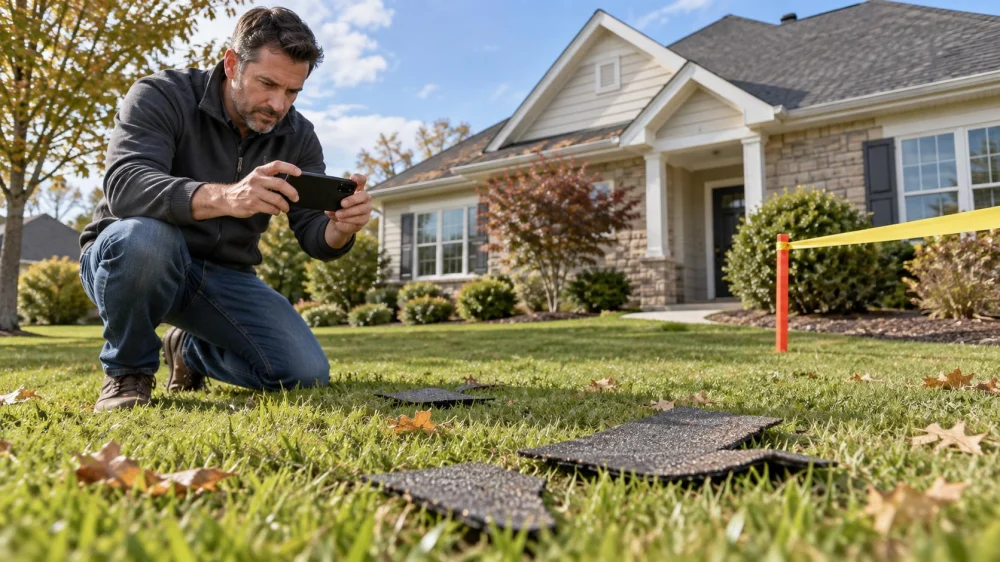
Roof Debris After Wind: Record Clues Without Climbing
On this page
Quick answer
After strong wind, keep people away from fallen material, overhead hazards, power lines, and the roof edge. Photograph debris where it landed before moving it, then capture the house from safe ground on every visible side. Note storm time, wind direction, interior moisture, and nearby tree damage. Do not climb onto the roof or reinstall pieces. Contact emergency services or the utility for immediate hazards, and a qualified roofer and insurer for documented next steps.

JK Contractors / jk roofing
West BendOzaukee CountyWisconsin
3058 County Rd Y, West Bend, WI 53095, USA
Make the area safe
Wait until official warnings and dangerous conditions have passed. Look for downed wires, unstable trees, hanging branches, loose gutters, broken glass, sharp metal, and material that may fall. Keep everyone indoors or behind a safe boundary as conditions require.
Treat every wire as energized and every suspended object as unstable. Do not move debris touching a wire or structure. Call the utility or emergency service.
If water is entering near electrical equipment, avoid the area and follow emergency guidance. Do not enter a sagging room or attic.

Absolute Roofing / absolute roofing
TimoniumBaltimore CountyMaryland
22 W Padonia Rd # B229, Timonium, MD 21093, USA
Record useful clues
Take wide photos showing where each piece landed and close views without touching it. Add a common object nearby for scale only when it can be placed safely. Photograph roof planes with camera zoom from the ground.
Record date, time, reported storm conditions, wind direction if known, noises heard, power changes, and when interior stains appeared. Save weather alerts and doorbell-camera footage.
Roofing fragments can resemble one another. Colour, granules, fastener holes, sealant, and break patterns are evidence for a professional—not proof of the exact source.
Arrange inspection and preserve evidence
Call the insurer according to the policy and ask what documentation and temporary protection it requires. Avoid permanent work before required inspection unless emergency action is needed to protect people or prevent further damage.
Choose a qualified roofer with appropriate insurance and safe-access procedures. Request photos, identified damage, temporary measures, permanent scope, price, exclusions, and disposal handling in writing.
If debris must be moved for safety, photograph it first, wear appropriate protection, preserve representative pieces in a secure dry location when permitted, and record where each came from.
Use a post-wind checklist
- Wait for safe conditions and check official alerts.
- Restrict access around wires, trees, glass, and falling material.
- Photograph debris in place and each elevation from ground level.
- Check occupied rooms for water or structural changes.
- Save storm, camera, roof, and warranty records.
- Notify the insurer and qualified roofer.
- Authorize only documented safe temporary protection.
- Track every visit, photo, estimate, and removed item.
Limitations and urgent boundaries
Ground photos cannot establish full roof condition, wind speed at the property, cause, or insurance coverage. Damage may be hidden and policies differ.
Call emergency services for collapse risk, fire, injury, or life-threatening conditions, and the utility for power-line hazards. Never climb a storm-damaged roof, use a ladder in wind, or approach a damaged tree.
Sources and evidence notes
The method follows post-storm safety and evidence-preservation principles: control access, avoid energized and overhead hazards, photograph before moving items, prevent further damage only when safe, use qualified inspectors, and maintain a dated record for repair and insurance decisions.
Frequently asked questions
Should I pick up shingles immediately?
Only after hazards are controlled and photos are taken. Do not approach wires, unstable trees, or falling-material zones.
Can I tell whether debris is mine?
Not reliably from appearance alone. A roofer should match it to documented roof areas.
Should I tarp the roof myself?
No if it requires roof or ladder access. Arrange qualified temporary protection.
What if no leak is visible?
Damage can still exist. Preserve evidence and obtain an appropriate inspection.
What records matter?
Dated photos, storm alerts, prior roof condition, warranties, communications, estimates, invoices, and completion evidence.
Conclusion and next steps
Control hazards first, photograph debris where it landed, and document the home from safe ground. Preserve storm and roof records, contact the appropriate utility, insurer, and qualified roofer, and keep temporary and permanent work clearly separated. Evidence is useful only when gathering it does not create another emergency.




 Highline Roofing and Gutters, Inc.4.0 (31 reviews)
 Good Vibes Roofing LLC5.0 (3 reviews)
 Rufus Roofing5.0 (22 reviews)
 Roofing Corp of America0.0 (0 reviews)
 Sutherlands Exteriors LLC5.0 (103 reviews)
 United Home Experts5.0 (28 reviews)
 Roofing Project Photos: Build a Useful Work Record
 How to Handle Roof Damage Insurance Claims Effectively
 How Long Should You Wait to Replace Your Roof After a Major Storm?
 The Signs of a Poor DIY Roof Repair That Now Needs Professional Attention
 How to Get a Free Roof Inspection: What’s Included and What’s Not
 How to Tell If Your Roof Was Installed Properly | Expert Roofing Tips