
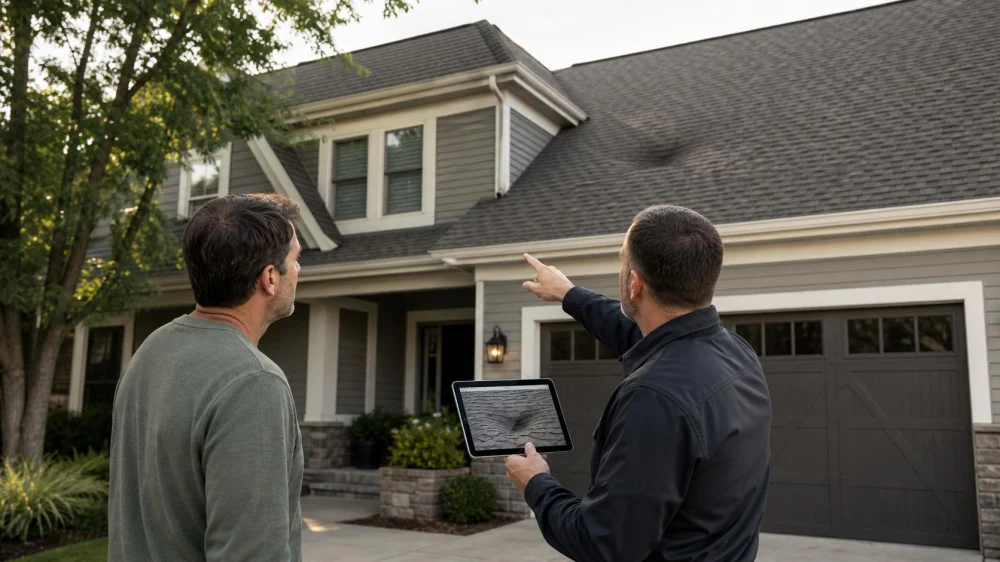
Roof Deck Soft Spots: Warning Signs to Check Safely
Table of contents
Quick answer
A roof deck soft spot is weakened or deflecting sheathing beneath the roof covering. Homeowners should not test for one by walking on the roof. Look instead for a wavy roofline, localized sagging, recurring ceiling stains, damp attic sheathing, or light around damaged areas. Keep clear of sagging ceilings and arrange a qualified roof and structural assessment promptly.
Absolute Roofing / absolute roofing
TimoniumBaltimore CountyMaryland
22 W Padonia Rd # B229, Timonium, MD 21093, USA
What a soft spot may mean
The roof deck is the structural surface—commonly plywood or oriented strand board—fastened over rafters or trusses beneath underlayment and shingles. A “soft spot” is a field description, not a complete diagnosis. It can indicate moisture-damaged sheathing, inadequate support, delamination, decay, a prior opening, or a localized installation problem. The covering above and framing below both need evaluation.
Lance Roofing & Siding Inc. / lance roofing and siding
6903 Dayton Springfield Rd, Enon, OH 45323, USA
Signs visible without roof access
- A dip, wave, or uneven plane that appears different from the surrounding slope.
- Shingles that look sunken, buckled, or repeatedly disturbed in one location.
- A roof edge that has changed shape or a soffit area that appears stained.
- Water marks that return in the same room after rain or snowmelt.
- Ceiling drywall that is bulging, cracking, or separating.
- A musty odor or peeling finish below the suspected area.
Photograph the whole slope and the suspected location from firm ground. Perspective, shadows, and normal framing lines can mimic a dip, so compare views from more than one safe position.
Safe indoor checks
From occupied rooms, note ceiling stains, bubbling paint, sagging, and when changes occur. If the attic has a proper walkway and safe access, inspect only from that walkway with a flashlight. Look for darkened sheathing, staining, rusted fasteners, wet insulation, mould-like growth, or visible deflection. Do not step between framing members, disturb insulation, touch wet wiring, or press on suspect sheathing.
Possible causes
Common contributors include a long-term roof leak, condensation from moisture and ventilation problems, an improperly flashed penetration, ice or wind damage, insufficient panel spacing or support, and sheathing that was already weakened before a reroof. Plumbing or HVAC condensation can also wet an attic, so water below a roof does not automatically identify the exterior source. Diagnosis should trace the moisture path and assess structural capacity.
When the situation is urgent
Keep people out of the area and seek urgent professional help when a ceiling is actively sagging, water is near electrical fixtures, the roofline changes suddenly, cracking sounds occur, framing appears displaced, or storm damage has opened the roof. If safe, contain dripping water from a distance and switch off affected electrical circuits only according to emergency guidance. Do not enter a compromised attic or place weight under a bulging ceiling.
Inspection checklist
Record the first-seen date, weather at the time, room and roof-slope location, wide and close photographs, changes after rain, roof age, reroof history, prior leak repairs, attic ventilation details, nearby vents or chimneys, and insurance or warranty documents. Ask the inspector to identify the moisture source, deck material and affected area, framing condition, temporary protection, repair scope, and whether permits are required.
Limits and safety boundaries
This general U.S. homeowner guidance cannot confirm deck strength or the source of moisture. Do not climb onto a roof, probe sheathing, open finished ceilings, or enter an attic with unsafe access, heat, mould, pests, exposed wiring, or suspected structural movement. Building codes, permit rules, product instructions, and licensing requirements vary by state and locality. A qualified on-site assessment controls the repair decision.
Evidence notes
A reliable evaluation connects exterior shape, roof-covering condition, moisture readings, attic observations, deck attachment, framing, and weather history. Dated photos help establish change over time, while moisture measurements and selective professional investigation help distinguish an active leak from old staining. Written findings should separate observed facts, probable cause, recommended repair, and areas that could not be inspected.
Frequently asked questions
Can I find a soft spot by stepping on the roof?
No. Testing it with body weight can cause a fall, break weakened decking, and damage shingles.
Does a ceiling stain prove the deck is rotten?
No. A stain shows past or present moisture, but deck condition requires inspection.
Can damaged sheathing be repaired from the attic?
Repair method depends on location, framing, roof covering, and code. Do not improvise structural work from below.
Will replacing shingles fix the soft area?
New shingles alone do not restore weakened decking. The underlying cause and damaged materials must be addressed.
Should I call a roofer or structural engineer?
Start with a qualified roof inspection. Significant sagging, framing movement, or uncertain load capacity may also require a structural engineer.
Next steps
Keep off the roof, photograph visible changes from the ground and indoors, document weather and leak timing, and move people away from any sagging ceiling. Schedule a qualified inspection promptly, request written findings for the deck and moisture source, and obtain an emergency response if deformation or active water near electricity is present.
 KGA Construction LLC5.0 (1 reviews)
 Renner Roofing Inc.4.0 (125 reviews)
 Merrimack Valley Roofing & Gutter LLC5.0 (4 reviews)
 Power Roofing & Exteriors Bronx5.0 (35 reviews)
 Excel Construction Group4.0 (63 reviews)
 Salus Exteriors5.0 (13 reviews)
 How to Fix a Leak in a Roof Where Two Different Roof Pitches Meet
 How to Choose a Roof Color for a House with a Lot of White Trim
 Best Roofing Materials for a Home in a Heavy Rainfall Climate
 How Solar Panels Affect Your Roof – What You Need to Know
 Best Roofing Materials for Homes in Wildfire-Prone Areas: Top Class A Options
 How to Finance a New Roof Without Breaking the Bank