
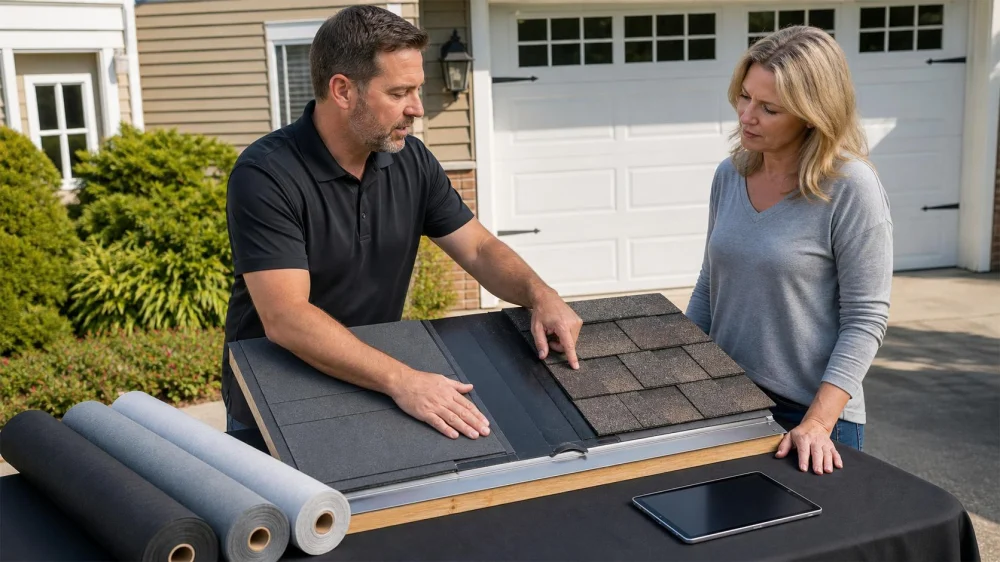
Roof Underlayment: What Homeowners Should Confirm
On this page
- Quick answer
- What roof underlayment does
- Common underlayment categories
- Where self-adhered membrane may be used
- Match underlayment to the roof system
- Confirm roof deck preparation
- Ask how edges and penetrations are detailed
- Understand weather and exposure limits
- Put the exact product in the contract
- Document installation without climbing
- Frequently asked questions
- Conclusion and next steps
Quick answer
Roof underlayment is a layer installed over the prepared roof deck and beneath the primary roofing. Before work starts, confirm the exact product, roof areas receiving it, fastening or adhesion method, deck requirements, exposure limit, and compatibility with shingles, metal, flashing, ventilation, and warranty terms. Ask how valleys, eaves, walls, and penetrations will be detailed, then request dated installation photos before the finished roof covers the layer.
This US homeowner guide is not a project specification. The roof design, product manufacturer, adopted building code, permit authority, climate, slope, and existing conditions determine the correct materials and installation.

Gunner Roofing / gunner roofing
CromwellLower Connecticut River Valley Planning RegionConnecticut
700 Corporate Row, Cromwell, CT 06416, USA
What roof underlayment does
Underlayment provides a secondary layer beneath shingles, metal panels, or another roof covering. Depending on the product and assembly, it can help shed incidental water during service, protect the deck during installation, separate materials, or meet a tested roof-system requirement.
It is not a substitute for sound decking, correct flashing, a properly installed primary covering, or good drainage. Water that repeatedly reaches the underlayment signals a problem that still needs correction.

Absolute Roofing / absolute roofing
TimoniumBaltimore CountyMaryland
22 W Padonia Rd # B229, Timonium, MD 21093, USA
Common underlayment categories
- Asphalt-saturated felt: a traditional roll product installed with specified laps and fasteners.
- Synthetic underlayment: a lighter sheet made from engineered polymers, with product-specific fastening and exposure rules.
- Self-adhered membrane: a peel-and-stick layer designed to seal around compatible fasteners and adhere to a properly prepared surface.
- Specialty underlayment: products designed for particular metal, tile, low-slope, high-temperature, or other assemblies.
Category names do not make products interchangeable. Compare current technical data and approvals for the planned assembly.
Where self-adhered membrane may be used
Project specifications or local requirements may call for self-adhered membrane at eaves, valleys, roof-to-wall transitions, around chimneys and skylights, or over a larger area. The intended coverage depends on climate, roof geometry, slope, substrate, and code.
Ask the contractor to mark membrane locations on the scope. More coverage is not automatically better if the roof assembly has not considered moisture drying, ventilation, deck condition, and product compatibility.
Match underlayment to the roof system
The roofing manufacturer may specify acceptable underlayment, cap-sheet, fastening, ventilation, and temperature conditions for warranty or tested performance. Some materials can react with one another or trap moisture when combined incorrectly.
Confirm compatibility with the primary roof covering, metal flashing, sealants, adhesives, fasteners, and any high-temperature exposure. Ask who is responsible for resolving conflicting instructions between products.
Confirm roof deck preparation
Underlayment needs a suitable surface. The contractor should inspect for rot, delamination, soft areas, gaps, protruding fasteners, contamination, and moisture before covering the deck. Replacement or repair requirements should follow the contract and a written change-order process.
Self-adhered products may require a clean, dry, smooth surface or primer under defined conditions. Felt and synthetic sheets still need correct deck attachment and a surface that will not damage the material.
Ask how edges and penetrations are detailed
Performance depends on sequence and transitions, not just field coverage. Discuss:
- eaves and rake edges;
- valleys and roof-to-wall intersections;
- chimneys, skylights, plumbing vents, and exhaust ducts;
- drip edge and flashing sequence;
- laps, seams, end joints, and repairs;
- temporary dry-in at unfinished areas.
Do not rely on exposed sealant as the primary plan for a layered drainage detail.
Understand weather and exposure limits
Underlayment can be damaged by wind, rain, heat, cold, foot traffic, and ultraviolet exposure. Manufacturers publish limits and installation conditions, but a maximum published exposure period is not a target schedule.
Ask how the crew will protect unfinished areas overnight and what happens after unexpected weather. Wrinkles, tears, loose fasteners, contaminated adhesive, or displaced sheets should be inspected and repaired before the roof covering hides them.
Put the exact product in the contract
The written scope should identify:
- manufacturer and product name;
- underlayment type and rated use;
- locations and number of layers;
- self-adhered membrane coverage;
- fastening, lap, and substrate requirements by referenced instructions;
- substitution and change-order process;
- related roof-system warranty.
A phrase such as “synthetic underlayment included” may be too vague to compare bids or verify a substitution.
Document installation without climbing
Ask the contractor for dated photos after deck preparation, during membrane and underlayment placement, and before the primary roof covering. Useful views show overall coverage plus valleys, eaves, walls, chimneys, skylights, and penetrations.
Stay off the roof and outside the active work zone. Review photos with the project manager and record questions in writing. Keep product wrappers, technical sheets, permits, inspection results, invoices, and warranty registration with the roof file.
Frequently asked questions
Can underlayment stop a roof leak by itself?
It is a secondary layer, not the finished drainage system. Persistent water entry still requires the source and roof detail to be corrected.
Is synthetic underlayment always better than felt?
No single category is best for every assembly. Suitability depends on product properties, roof covering, slope, climate, installation, code, and warranty requirements.
Should the entire roof receive peel-and-stick membrane?
Only when the designed assembly, code, manufacturer, and moisture strategy support it. Ask a qualified professional to evaluate the whole system.
Can underlayment be left exposed for weeks?
Products have specific limits, and weather can cause damage before that limit. Confirm the schedule and require inspection before covering any exposed material.
Conclusion and next steps
Ask the roofer to identify the exact underlayment and membrane locations, show compatibility with the roof system, and explain deck preparation, transitions, weather protection, and substitutions. Put those details in the contract and collect dated photos before shingles or panels cover the work. Specific manufacturer instructions and local requirements should govern the final installation.

 Marshall Roofing Siding & Windows4.0 (207 reviews)
 Roof Advance5.0 (14 reviews)
 Lasher Roofing & Contracting5.0 (1 reviews)
 Durable Roofing Solutions Inc.5.0 (2 reviews)
 Schroeder Roofing4.0 (22 reviews)
 RainDance Roofing4.0 (67 reviews)
 How to Clean Your Roof Without Damaging the Shingles' Fire Rating
 How Long Does Roof Installation Take? Timeline Explained
 How to Install Drip Edge on a Roof That Never Had It Before
 How to Clean Your Roof with a Leaf Blower for Regular Debris Maintenance
 The Best Roofing Nails for the Job: Material, Length, and Shank Type Explained
 Do You Need to Replace Roof Before Selling? A Complete Guide