
Why Roof Valleys Leak and What Homeowners Should Check
On this page
- Quick answer
- Why roof valleys are vulnerable
- Common roof-valley leak causes
- Ground-level exterior clues
- Interior and attic clues
- Why surface caulk is rarely the full answer
- What a professional inspection should cover
- Urgent signs, limitations, and evidence notes
- Frequently asked questions
- Conclusion and next steps
Quick answer
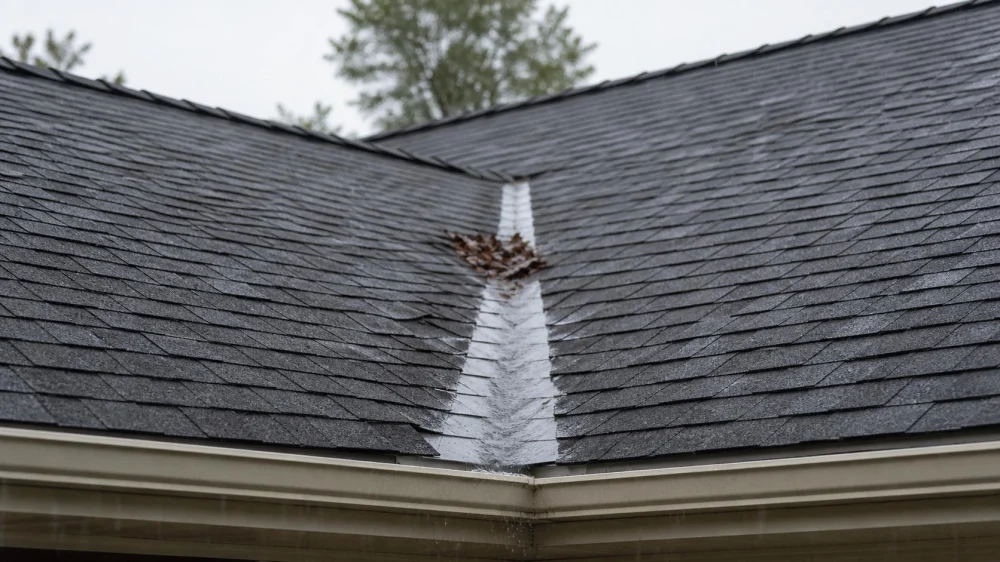
A roof valley is the inward channel where two sloped roof sections meet. It carries concentrated runoff, so debris, damaged shingles or metal, poor cuts, fasteners in the water path, failed underlayment, ice, or deck movement can lead to leakage. Check from the ground and inside, record where staining appears, and hire a qualified roofer to inspect the full valley assembly rather than covering the surface with caulk.

Gunner Roofing / gunner roofing
CromwellLower Connecticut River Valley Planning RegionConnecticut
700 Corporate Row, Cromwell, CT 06416, USA
Why roof valleys are vulnerable
Roof valleys collect water from two adjacent slopes and direct it toward the eave. During heavy rain, snowmelt, or ice thaw, the flow can be much greater than on an open field of shingles. Leaves, needles, seeds, and roof granules also tend to collect along the low line.
Common asphalt-roof valley styles include:
- Open valley: Exposed sheet metal or another approved lining remains visible in the centre.
- Closed-cut valley: Shingles from one slope cross the valley and shingles from the other are cut along a designed line.
- Woven valley: Shingle courses from both slopes interweave where the product and roof conditions allow it.
No style is universally best for every roof. Product instructions, slope, shingle type, climate, roof geometry, and local requirements determine acceptable details.

Rapid Response Roofing / rapid response roofing
East GreenvilleMontgomery CountyPennsylvania
408 State St, East Greenville, PA 18041, USA
Common roof-valley leak causes
- Debris buildup: Organic material can slow runoff, retain moisture, redirect water sideways, and conceal damage.
- Damaged valley metal: Corrosion, punctures, open seams, movement, or mechanical damage can compromise an exposed lining.
- Incorrect cuts: Jagged or poorly located shingle cuts can expose fasteners, create narrow channels, or direct water beneath the covering.
- Fasteners in vulnerable locations: Nails or screws placed too close to the valley centre or outside approved zones may create openings.
- Missing or failed underlayment: The concealed backup layer may be damaged, lapped incorrectly, or unsuitable for the assembly.
- Broken or lifted shingles: Age, wind, impact, foot traffic, and previous repairs can expose the valley edge.
- Ice and snow: Freeze-thaw and ice buildup can slow drainage and push water into vulnerable laps.
- Deck or framing movement: Sagging, uneven sheathing, or structural movement can distort the drainage channel.
- Complex intersections: Dormers, walls, chimneys, upper roofs, and short dead valleys may require additional drainage and flashing details.
The visible valley may not be the original entry point. Water can enter higher at a wall, penetration, or roof transition and travel along sheathing or underlayment.
Ground-level exterior clues
Use binoculars or camera zoom from stable ground in safe weather. Do not climb a ladder or walk a valley, which can be steep, slippery, and easily damaged.
- Leaves, needles, branches, or ice concentrated in the channel
- Missing, cracked, curled, or lifted shingles along the valley edge
- Uneven or narrowing valley lines
- Exposed or rusted fasteners
- Bent, corroded, stained, or punctured metal
- Sealant patches or mismatched repairs
- Sagging or a low point that holds water
- Overflow at the eave, gutter, or valley outlet during rain
Record the roof slope, valley, date, weather, and camera position. A photo from the same location after different storms can show whether the pattern changes.
Interior and attic clues
Inside finished rooms, look for stains near the line where roof slopes meet, but do not assume the visible spot is directly below the defect. Water can travel along rafters, trusses, pipes, insulation, and ceiling surfaces.
Note:
- When the stain appears: rain, wind-driven rain, snowmelt, or freeze-thaw
- Whether it grows, changes colour, bubbles paint, or smells damp
- Its relationship to exterior walls, dormers, chimneys, and upper roof sections
- Whether electrical fixtures, smoke alarms, or wiring are nearby
Enter an attic only through safe permanent access with stable footing and no electrical, structural, mould, animal, insulation, or air-quality hazard. From a safe point, photograph wet sheathing, dark trails, frost, rusted fasteners, and damp insulation without touching or disturbing materials.
Keep away from a bulging ceiling. Turn off power only through a safe, known procedure when water affects electrical components, and contact the appropriate emergency or electrical professional.
Why surface caulk is rarely the full answer
Roof valleys manage moving water through layered materials and carefully located laps. Smearing generic sealant across a crack may hide the symptom while leaving damaged shingles, metal, underlayment, deck, or upstream flashing unchanged.
Sealant can also create a small dam, redirect water sideways, trap moisture, interfere with material movement, and make a later repair harder. Walking in the valley to apply it can damage shingles and creates serious fall risk.
Do not pressure-wash, scrape metal, chip ice, pry shingles, drill drainage holes, or fasten loose materials from above. Emergency protection should be installed only by people trained and equipped for the roof, weather, and building conditions.
What a professional inspection should cover
- Trace the water path. Compare exterior details, attic evidence, interior stains, and weather patterns.
- Identify the valley type. Check whether materials and layout follow the applicable product design.
- Inspect the upper end. Review ridge, dormer, wall, chimney, and intersecting-roof details that feed the valley.
- Check shingle cuts and fasteners. Look for exposed nails, narrow channels, bridging, loose seals, and brittle material.
- Assess metal and underlayment. Evaluate laps, corrosion, damage, width, movement, and concealed backup where investigation permits.
- Check the deck. Look for softness, staining, decay, sagging, unsupported joints, and moisture.
- Evaluate discharge. Confirm water leaves the valley into a suitable eave, gutter, or lower-roof detail without overshooting or backing up.
- Define repair limits. Explain what will be removed, replaced, integrated, tested, and warranted.
Ask for photos before and after work. A sound proposal should address the water path and damaged layers, not only the first visible opening.
Urgent signs, limitations, and evidence notes
Seek prompt help for active dripping, wet insulation, an expanding stain, damaged valley metal, missing shingles, or leakage during every storm. Treat water near electricity, a bulging ceiling, structural sagging, falling material, or widespread wind damage as urgent; keep people away and follow emergency guidance.
This article reflects common steep-slope roof-valley practice in the United States. It cannot determine installation compliance, code requirements, deck condition, or repair scope from ground photos. Roof type, slope, product, climate, previous work, and geometry all change the correct detail.
Building codes, permits, contractor rules, and manufacturer requirements vary by state, municipality, roof system, and project scope. Preserve warranties and inspection records and use an appropriately qualified, insured contractor.
Frequently asked questions
Can leaves alone make a roof valley leak?
Debris can slow and redirect water, but a properly designed roof still needs inspection if leakage occurs. Leaves may reveal or worsen an underlying cut, fastener, underlayment, metal, or deck problem.
Is an open metal valley better than a closed valley?
Each can perform well when suitable for the roof and installed according to product and local requirements. Choice depends on shingle type, slope, climate, geometry, appearance, and approved details.
Can a roof valley leak only during wind-driven rain?
Yes. Wind can push water across normal flow paths and into lifted edges or vulnerable laps. Document wind direction and the affected interior area for the roofer.
Why is the ceiling stain away from the valley?
Water may travel along sheathing, framing, underlayment, insulation, or ceiling surfaces before appearing. The stain location is evidence, not proof of the entry point.
Does a leaking valley require full roof replacement?
Not always. A localized valley rebuild may be possible when surrounding materials remain serviceable. Widespread brittleness, deck damage, multiple failures, or poor integration can justify broader work.
Conclusion and next steps
Photograph the valley and interior clues from safe locations, record the weather pattern, and protect people from active water and electrical hazards. Do not walk the valley or cover it with generic caulk. Ask a qualified roofer to trace runoff from the valley's upper end to the eave and explain how the repair restores every affected layer.


 Five Stars Quality Construction, Inc.4.0 (140 reviews)
 Portland Quality Roofing Inc5.0 (7 reviews)
 Nextop Roofing5.0 (43 reviews)
 Eden Roofing & General Contractors NYC4.0 (9 reviews)
 sjjsroofingcontractorscorp0.0 (0 reviews)
 Varni Roofing4.0 (53 reviews)
 Top Questions to Ask Before Hiring a Roofing Company: A Complete Guide
 Cost to Replace Roof After Fire Damage: Understanding the Expenses and Process
 Installing a Modified Bitumen Roof for a Low-Slope Garage: Step-by-Step Process
 Green Roofs: How They Work, Benefits, and Installation Considerations for Your Home
 The True Cost of Roof Replacement When You Have to Replace Rotted Rafters
 How to Tell If Your Roof Was Installed Properly