
Roof Drip Edge Repair: Eaves, Underlayment, and Gutters
On this page
Quick answer
Drip edge repair should restore a continuous, code-compliant path that protects roof sheathing and directs water away from fascia and into the gutter. From the ground, document staining, rot, peeling paint, gaps, lifted metal, and water behind gutters. Have a roofer inspect underlayment, shingles, deck edges, fascia, fasteners, laps, corners, and gutter position, then specify compatible metal and sequencing in writing.

JK Contractors / jk roofing
West BendOzaukee CountyWisconsin
3058 County Rd Y, West Bend, WI 53095, USA
What drip edge does
Drip edge is metal flashing at eaves and rakes. It protects the sheathing edge, supports roof-edge water control, and helps direct runoff away from fascia. Its relationship to underlayment differs at eaves and rake edges under applicable codes and systems, so simply sliding in a loose strip may not restore the detail.
Gutter aprons, starter strips, membranes, metal roofs, tile roofs, and wildfire or high-wind requirements can change the design.

Rapid Response Roofing / rapid response roofing
East GreenvilleMontgomery CountyPennsylvania
408 State St, East Greenville, PA 18041, USA
Ground-level clues
- Water streaks or paint failure on fascia and soffit
- Soft, swollen, split, or darkened wood at roof edges
- Water running behind the gutter
- Bent, missing, short, or separated metal sections
- Loose starter shingles or exposed underlayment
- Gutter fasteners pulling out or gutter pitched away
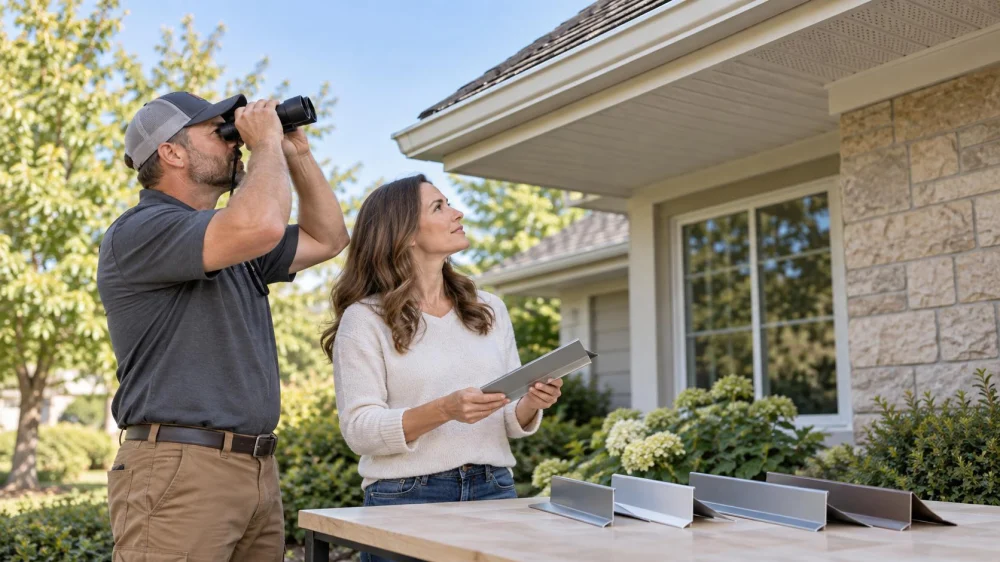
Use binoculars or zoom photos from the ground. Do not lean from windows, climb gutters, or lift shingles yourself.
Professional assessment
The roofer should determine whether the issue is limited to metal or includes damaged deck, fascia, subfascia, soffit, membrane, starter, shingles, or gutter attachment. Ask how far hidden damage may extend and how it will be exposed without creating additional leaks.
Check whether past reroofing layered materials incorrectly and whether ice, wind, or blocked gutters contributed.
Define the repair
The written scope should identify metal material, profile, dimensions, colour, lap and corner treatment, fasteners, underlayment sequence, starter and shingle removal, deck and fascia allowances, sealant use, code, manufacturer requirements, and weather protection. Avoid a sealant-only proposal when the water path or damaged substrate remains unresolved.
Coordinate gutters
Specify whether gutters must be loosened, removed, reset, or replaced and who is responsible. Confirm that runoff enters the gutter without overshooting or running behind it and that the gutter does not block the roof-edge detail. Downspouts and drainage still need capacity and a discharge route away from the foundation.
Closeout records
Photograph exposed deck and fascia, underlayment sequence, metal laps, corners, fasteners, starter, shingles, and reset gutters before each layer is covered. Collect permits, product information, invoice, warranty, and a description of replaced wood. Recheck from indoors and the ground during later rain without entering unsafe areas.
Frequently asked questions
Can drip edge be added without reroofing?
Sometimes, but feasibility depends on the roof system, condition, sequencing, code, and manufacturer requirements.
Is caulk enough for a gap?
Usually not when the metal, lap, substrate, or water path is wrong.
Does gutter replacement include drip edge?
Not automatically. Put each trade's scope and interface in writing.
Why is fascia still wet?
Overflow, behind-gutter flow, roof-edge details, ice, and other leaks can contribute and need diagnosis.
Sources and notes
FEMA's Wind Retrofit Guide for Residential Buildings describes drip edge at eaves and rakes as protection for sheathing edges that helps move water away from fascia, with underlayment and attachment details governed by the applicable standard.
Next steps
Document clues from the ground, obtain a roof-edge and gutter assessment, and require a detailed scope covering hidden damage, metal, underlayment, starter, fasteners, and drainage. Photograph each concealed layer and retain product, permit, invoice, and warranty records.


 Roofing Company Near Me Deerfield Beach5.0 (33 reviews)
 FRG Construction And Developers Inc.4.0 (14 reviews)
 DBS Roofing and General Contractors4.0 (50 reviews)
 Friendly Roofing5.0 (13 reviews)
 Expert Team Roofers5.0 (1 reviews)
 Greene’s Professional Roofing Services Boca Raton4.0 (45 reviews)
 Roofing Crew Access: Gates, Pets, and Daily Lockup
 Roof Nail Pops: Document Clues Before a Contractor Visit
 Roof Debris After Wind: Record Clues Without Climbing
 Roof Sealant Claims: Separate a Patch From a Lasting Repair
 Fascia and Soffit Repair: Define the Roofing Scope
 Attic Ventilation and Roofing: Calculate Before You Change It