
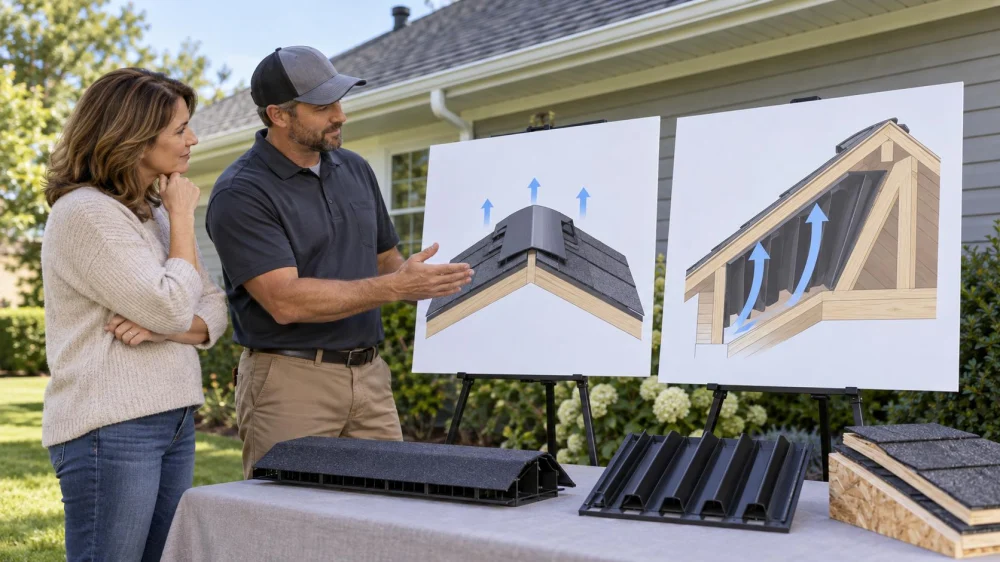
Roof Ridge Vent Replacement: Openings, Baffles, and Caps
On this page
Quick answer
A ridge vent should not be replaced as an isolated strip of plastic or metal. Have a roofing professional assess whether the attic is vented or unvented, measure intake and exhaust openings, check soffit vents and baffles, inspect insulation and air sealing, and match the ridge slot, vent product, fasteners, end plugs, and cap shingles to code and manufacturer instructions. Document the completed system.

JK Contractors / jk roofing
West BendOzaukee CountyWisconsin
3058 County Rd Y, West Bend, WI 53095, USA
Treat ventilation as a system
Ridge exhaust depends on usable intake, commonly at soffits, and a clear path through each intended rafter bay. Blocked intake, missing baffles, insulation in the eaves, air leaks from the house, or mixed vent types can undermine performance. Some roofs are intentionally unvented and should not receive a ridge vent without redesign.
Ventilation does not repair roof leaks, wet sheathing, bath fans discharging into the attic, or major ceiling air leakage. Identify each cause separately.

Rapid Response Roofing / rapid response roofing
East GreenvilleMontgomery CountyPennsylvania
408 State St, East Greenville, PA 18041, USA
Inspect before replacement
- Roof material, slope, ridge length, hips, and intersecting roofs
- Existing vent product, ridge slot width, and termination points
- Soffit intake area and baffle continuity
- Attic moisture, staining, mould, rust, pests, and compressed insulation
- Ceiling penetrations and duct termination
- Wind, rain, snow, wildfire, and local code exposure
Inspection should be from safe roof and attic access by qualified people. Do not walk a steep, wet, icy, brittle, or damaged roof.
Define the work scope
The proposal should state how old caps and vent are removed, how decking and slot edges are assessed, which damaged material is replaced, how the opening is corrected, and which vent, nails, sealants, and cap shingles are installed. Include weather protection, debris control, attic cleanup, warranty, permits, and photographs.
Ask what happens if the ridge slot is too wide, too narrow, discontinuous, or cut across structural framing.
Confirm key details
The contractor should follow the vent and roof-covering manufacturers for slot dimensions, fastener length and spacing, end closures, overlaps, sealant locations, cap exposure, and high-wind requirements. Confirm that the vent will not obstruct valleys, chimneys, fire separations, or access paths.
Inside, baffles should preserve the intended air channel above insulation. The total ventilation design must meet local code and the assembly's moisture strategy.
Closeout checks
Review straightness, secure caps, closed ends, proper ridge terminations, cleared gutters and grounds, and attic debris. Obtain before-and-after photos of the slot, deck repairs, vent attachment, and caps; product labels; permits; invoice; and warranty. Ask when the attic should be rechecked for moisture or wind-driven entry.
Safety and limits
Stay off the roof and away from attic electrical hazards, weak ceilings, extreme heat, mould, and animal contamination. A powered attic fan or more exhaust is not automatically an improvement and can change pressure or pull conditioned air from the house. Use building-science and code review for unusual assemblies.
Frequently asked questions
Can I add a ridge vent without soffit vents?
Not as a default. A professional should calculate and design the complete intake and exhaust path.
Should box vents remain?
Mixed exhaust types can short-circuit airflow; ask the designer what should remain or be closed.
Does a ridge vent stop ice dams?
It can be one component, but air sealing, insulation, snow, and weather also matter.
Why are baffles important?
They maintain a clear channel between soffit intake and upper roof while keeping insulation in place.
Sources and notes
The U.S. Department of Energy's Building Science Education resource explains how attic baffles maintain an air gap, guide air from soffit vents toward a ridge vent, and protect insulation performance. Local code and manufacturer instructions govern each installation.
Next steps
Confirm whether the attic is designed to be vented, measure the full intake and exhaust path, inspect baffles and air leakage, and obtain a written replacement scope. Collect slot, attachment, cap, attic, product, and warranty records at closeout.


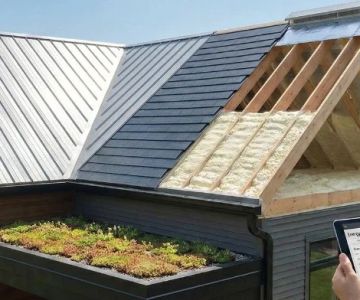
 Roofing Company Near Me Deerfield Beach5.0 (33 reviews)
 FRG Construction And Developers Inc.4.0 (14 reviews)
 DBS Roofing and General Contractors4.0 (50 reviews)
 Friendly Roofing5.0 (13 reviews)
 Expert Team Roofers5.0 (1 reviews)
 Greene’s Professional Roofing Services Boca Raton4.0 (45 reviews)
 Roofing Crew Access: Gates, Pets, and Daily Lockup
 Roof Nail Pops: Document Clues Before a Contractor Visit
 Roof Debris After Wind: Record Clues Without Climbing
 Roof Sealant Claims: Separate a Patch From a Lasting Repair
 Fascia and Soffit Repair: Define the Roofing Scope
 Attic Ventilation and Roofing: Calculate Before You Change It